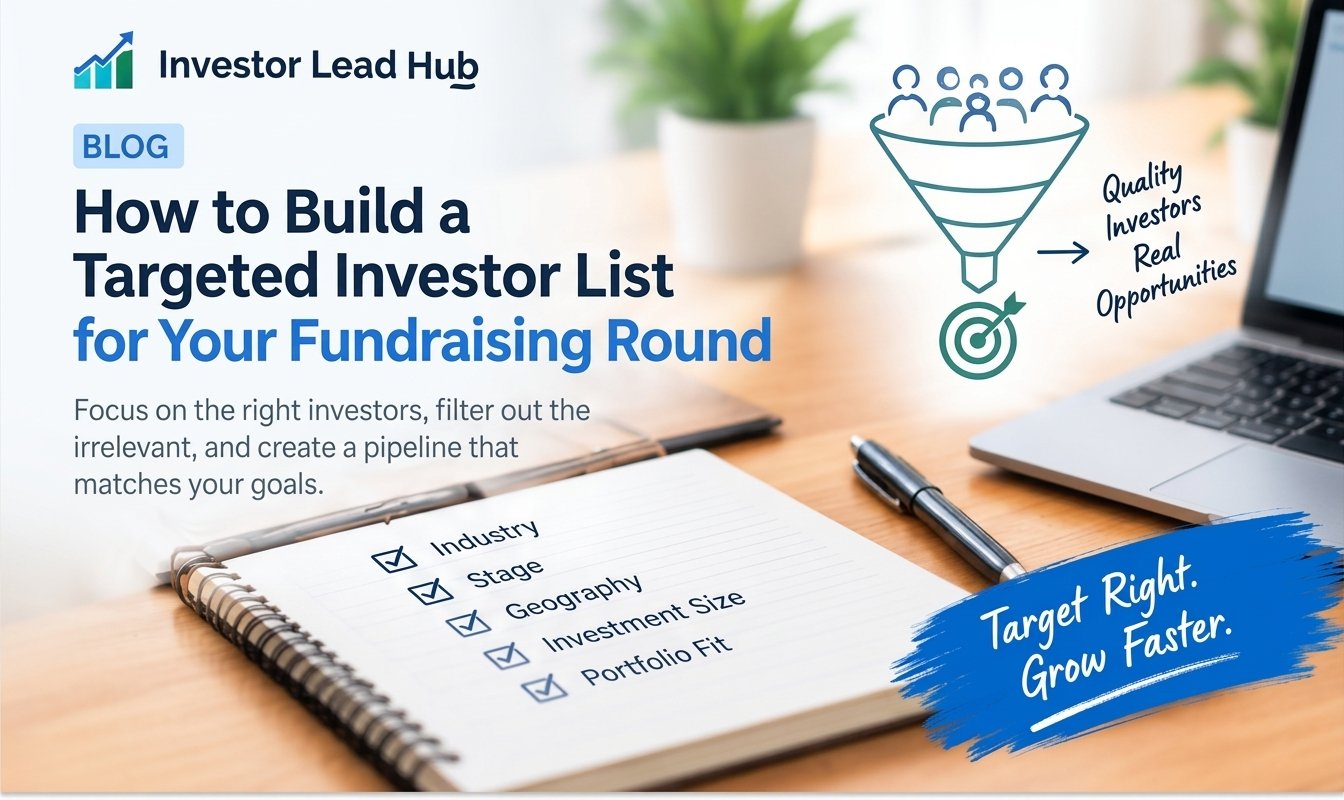
Finding investors for a startup is not simply about collecting hundreds of investor names and sending the same pitch to everyone. The real challenge is identifying investors whose investment focus, stage, geography, portfolio, and check size match your business.
A targeted investor search can help founders spend less time researching irrelevant prospects and more time building relationships with investors who may actually fit their fundraising goals.
In this guide, we explain how to find investors for your startup, how to research potential investors, and how to build an organized investor pipeline for your next funding round.
Why Finding the Right Investors Matters
Every investor has different preferences. Some focus on early-stage startups, while others primarily invest in growth-stage companies. Some specialize in specific industries such as SaaS, fintech, healthcare, artificial intelligence, or climate technology.
Geography can also matter. An investor may only invest in certain countries or regions, while another may have a global investment strategy.
This means that a large investor database is not necessarily useful if most of the contacts are irrelevant to your company.
A more effective approach is to build a targeted investor list based on:
-
Your funding stage
-
Industry and business model
-
Target geography
-
Funding amount
-
Investor type
-
Investment thesis
-
Typical check size
-
Relevant portfolio companies
-
Recent investment activity
Investor Lead Hub uses these criteria when researching investors for startups and growing businesses. Its research process includes defining investor requirements, identifying prospects, qualifying them, verifying data, and delivering an organized investor pipeline.
Step 1: Define Your Fundraising Requirements
Before searching for investors, clearly define what you are looking for.
Start with your current funding stage. For example, you may be raising:
-
Pre-Seed
-
Seed
-
Series A
-
Series B
-
Growth capital
Next, determine how much capital you are raising.
Your target raise helps you identify investors whose typical investment size is compatible with your round.
You should also define your target geography. You might want investors from the United States, Europe, Asia, the Middle East, or a specific country or city.
Finally, identify your industry and business model.
For example, an AI SaaS startup could specifically search for investors interested in artificial intelligence, enterprise software, SaaS, and early-stage technology companies.
Step 2: Decide Which Type of Investor You Need
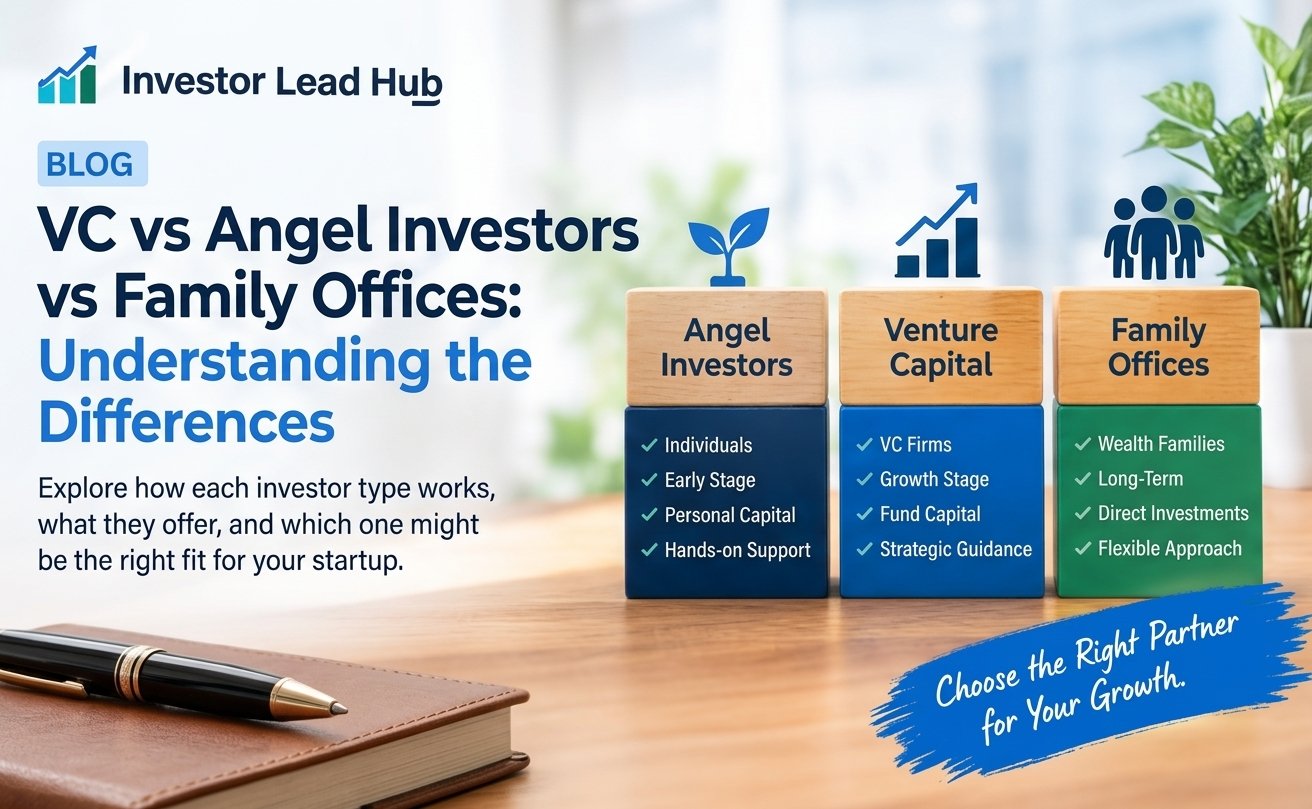
Startups can approach several types of investors.
Venture Capital Firms
Venture capital firms invest in startups with growth potential and typically operate according to a defined investment strategy.
When researching a VC, look at its:
-
Investment stage
-
Industry focus
-
Geographic focus
-
Typical check size
-
Portfolio
-
Recent investments
-
Relevant partners
You can explore Investor Lead Hub's Venture Capital Firm Research service to understand how targeted VC research can be structured.
Angel Investors
Angel investors are individuals who invest their own capital into businesses. Some angels are experienced entrepreneurs or operators who can also bring industry knowledge and networks.
For early-stage founders, relevant angel investors may be particularly useful when they have experience in the same industry or business model.
Investor Lead Hub provides Angel Investor Research focused on identifying angels, operator-investors, and angel networks according to industry, stage, location, and investment focus.
Family Offices
Family offices manage wealth for individuals or families and may have different investment strategies from traditional VC firms.
Some family offices make direct investments in businesses and can be relevant for companies seeking larger or longer-term capital relationships.
You can learn more through Investor Lead Hub's Family Office Research service.
Private Equity Firms
Private equity firms generally focus on more mature businesses, although their investment strategies vary.
If your company is at a growth stage and has the scale or financial profile required by a particular PE investor, researching relevant firms may expand your fundraising options.
Investor Lead Hub also provides Private Equity Firm Research.
Step 3: Research the Investor's Investment Thesis
Finding an investor's name is only the beginning.
Before adding an investor to your outreach list, investigate what they actually invest in.
Look for:
-
Industries they invest in
-
Company stages
-
Geographic preferences
-
Business models
-
Investment size
-
Recent deals
-
Portfolio companies
-
Partners responsible for your sector
For example, if you operate a fintech startup, an investor with a strong fintech portfolio may be more relevant than a generalist investor with no demonstrated interest in financial technology.
Step 4: Review the Investor's Portfolio
Portfolio research can reveal whether an investor has experience with businesses similar to yours.
Look for companies that share:
-
Similar industry
-
Similar customer base
-
Similar business model
-
Similar funding stage
-
Similar geographic market
Portfolio research can also help you identify potential conflicts. If an investor already backs a direct competitor, that may affect whether you want to approach them.
The goal is not simply to find investors who have money. It is to find investors whose existing investment activity provides evidence of potential relevance.
Step 5: Identify the Right Decision Maker
Another common fundraising mistake is contacting the wrong person.
Large investment firms may have partners, principals, associates, analysts, and other team members.
If you are researching a VC firm, try to identify the partner or principal who covers your sector or stage.
For an angel investor, identify the individual directly.
A targeted investor database should ideally include:
-
Investor or firm name
-
Decision maker
-
Role
-
Location
-
Investment focus
-
Portfolio
-
Contact information
-
Relevant background
This makes your outreach process much more organized.
Step 6: Verify Investor Information
Investor information can change quickly.
People move between firms. Investment strategies change. Email addresses become outdated. Funds may stop investing in particular stages or regions.
For this reason, investor research should include a verification step.
Investor Lead Hub describes its research process as manually reviewing investor relevance, investment activity, portfolio information, and business contact details before delivery.
This type of qualification can help reduce wasted outreach to inactive or poorly matched prospects.
Step 7: Build a Targeted Investor Pipeline
Once your research is complete, organize investors into a structured pipeline.
A simple investor pipeline could include:
| Field | Example |
|---|---|
| Investor | ABC Ventures |
| Investor Type | Venture Capital |
| Stage | Seed |
| Industry | SaaS |
| Geography | United States |
| Check Size | Relevant range |
| Decision Maker | Partner |
| Portfolio Fit | High relevance |
| Contact | Verified business email |
| Outreach Status | Not contacted |
You can then track outreach, responses, meetings, follow-ups, and next steps.
Step 8: Personalize Your Investor Outreach
Do not send the exact same message to every investor.
Use your research to personalize your outreach.
Mention a relevant portfolio company, investment theme, market, or reason your startup fits the investor's strategy.
A concise message can explain:
-
What your company does
-
What problem you solve
-
Your current traction
-
How much you are raising
-
Why you believe the investor may be relevant
-
What you are asking for
Personalization does not mean writing an extremely long email. It means showing that you understand why you are contacting that particular investor.
When Should You Start Investor Research?
Ideally, investor research should begin before you urgently need capital.
Building an investor pipeline takes time. Researching investors, identifying decision makers, preparing outreach, holding meetings, and managing follow-ups are all parts of the fundraising process.
Starting early gives you more time to understand the investor landscape and refine your target list.
How Investor Research Can Save Founders Time
Founder time is limited.
Searching through websites, databases, portfolios, LinkedIn profiles, investment announcements, and company pages can take many hours.
Professional investor research can organize this work into a structured process.
Investor Lead Hub states that its research is customized around factors such as industry, funding stage, geography, investment size, and investor profile.
For founders who want to focus their time on pitching and relationship-building, a qualified investor pipeline can provide a more structured starting point.
Frequently Asked Questions
How do I find investors for my startup?
How many investors should I contact?
What information should I research about an investor?
Should startups contact venture capital firms or angel investors?
How can I find the right VC for my startup?
What is investor research?
Conclusion
Finding investors is not about reaching the largest possible number of people. It is about identifying investors whose investment strategy and experience align with your company's fundraising requirements.
A focused process—define your criteria, research investors, review portfolios, identify decision makers, verify information, and organize your pipeline—can make investor outreach more structured and efficient.
If you need help building a customized investor pipeline, you can start your investor research with Investor Lead Hub.