A strong fundraising process starts with strong investor research.
Many founders begin fundraising by collecting investor names from search engines, directories, LinkedIn, and online databases. While this can produce a long list, quantity alone does not create a useful investor pipeline.
A targeted investor list is different.
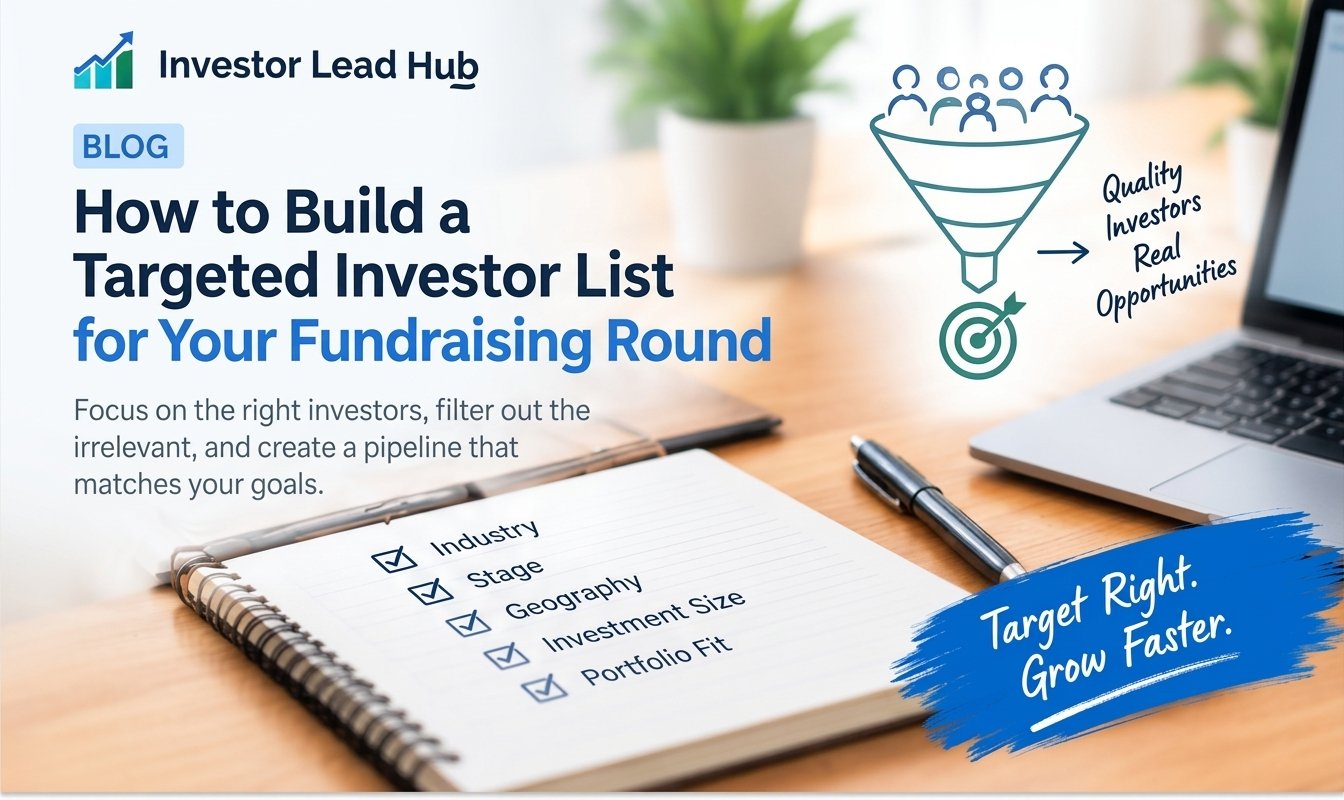
It is built around your company's industry, funding stage, geography, capital requirements, business model, and ideal investor profile.
In this guide, we'll explain how to build a targeted investor list and what information you should collect before beginning investor outreach.
What Is a Targeted Investor List?
A targeted investor list is a researched group of potential investors selected according to specific fundraising criteria.
Instead of including every investor you can find, the list focuses on prospects that may have a relevant investment profile.
A targeted list can include:
-
Venture capital firms
-
Angel investors
-
Family offices
-
Private equity firms
-
Corporate investors
-
Strategic investors
-
Other relevant capital providers
The exact investor categories depend on the company's stage and fundraising requirements.
Why Generic Investor Lists Can Be a Problem
A generic investor database may contain thousands of contacts.
However, many may not be relevant to your company.
For example, an investor might:
-
Invest only in later-stage companies
-
Focus on another industry
-
Invest only in a different geography
-
Write checks much larger than your target
-
No longer invest actively
-
Have no interest in your business model
If you contact these investors anyway, your team spends time on outreach that was unlikely to fit from the beginning.
Targeted research helps narrow the universe of investors before outreach begins.
Step 1: Define Your Ideal Investor Profile
Start by writing down exactly what you want.
Your criteria might include:
Industry: SaaS
Stage: Seed
Geography: United States and Europe
Raise: $2 million
Investor type: VC and angels
Business model: B2B
Preferred investor: Experience in enterprise software
This creates a research brief.
The more clearly you define your criteria, the easier it becomes to evaluate potential investors.
Step 2: Identify Relevant Investor Categories
Not every company needs the same investor pipeline.
For example, an early-stage technology startup might research angel investors and VC firms.
A more established business might also research private equity firms, family offices, corporate investors, or strategic investors.
Investor Lead Hub researches multiple investor types, including venture capital firms, angel investors, family offices, and private equity firms.
The important point is to match the investor category to the company's actual fundraising requirements.
Step 3: Research Investors by Industry
Industry fit is one of the most useful filters.
Suppose you operate an AI startup.
You may want investors with experience in:
-
Artificial intelligence
-
Machine learning
-
Enterprise software
-
Automation
-
Data infrastructure
If you operate a fintech company, you may instead research investors with experience in:
-
Payments
-
Banking technology
-
Financial software
-
Insurtech
-
Financial infrastructure
Investor Lead Hub states that its research can be customized around a company's sector and sub-sector.
Step 4: Filter Investors by Funding Stage
Your funding stage is another important qualification factor.
An investor that focuses on growth-stage companies may not be appropriate for a Pre-Seed startup.
Similarly, a company raising a large growth round may need to look beyond investors that primarily focus on very early-stage deals.
Research whether the investor actively participates in:
-
Pre-Seed
-
Seed
-
Series A
-
Series B
-
Growth
-
Other relevant stages
The goal is to identify investors whose current strategy aligns with your fundraising round.
Step 5: Consider Geographic Focus
Geography can influence investment activity.
Some investors focus on specific countries, cities, or regions.
Others invest globally.
When creating your investor list, record:
-
Headquarters
-
Investment regions
-
Target countries
-
Local offices
-
Relevant market experience
If your company is expanding internationally, investors with experience in the target market may also provide useful networks and knowledge.
Step 6: Research Investment Size
Your fundraising target should be considered when qualifying investors.
If you are raising $1 million, an investor that normally makes much larger investments may not be a practical target.
Similarly, a company raising a significant growth round may need investors capable of participating at that level.
Research each investor's typical investment range where information is available.
Do not rely solely on a single historical deal. Investment strategies can change over time.
Step 7: Analyze the Investor's Portfolio
Portfolio analysis is one of the most important steps in building an investor list.
Look for companies that resemble yours.
Relevant similarities might include:
-
Industry
-
Business model
-
Target customer
-
Geography
-
Company stage
-
Technology
-
Growth model
Portfolio research can also reveal potential competitive conflicts.
For example, if an investor already owns a significant investment in a direct competitor, you may want to consider that when deciding whether to include them in your outreach pipeline.
Step 8: Identify the Right Decision Maker
A company or fund is not always the person you should contact.
Your investor list should identify the relevant decision maker whenever possible.
For a VC firm, this might be:
-
General Partner
-
Managing Partner
-
Partner
-
Principal
For an angel investor, it may be the investor directly.
The relevant contact depends on the investor organization.
Investor Lead Hub's research process includes identifying relevant decision makers and verifying available business contact information.
Step 9: Verify the Data
A targeted list is only useful if its information is reliable.
Before outreach, check:
-
Investor name
-
Firm name
-
Role
-
Website
-
Investment focus
-
Recent activity
-
Portfolio
-
Email
-
LinkedIn profile
-
Geography
Investor information changes regularly, so verification should be part of the research process.
Investor Lead Hub describes its approach as manually researching and verifying investor information rather than relying solely on generic scraped lists.
Step 10: Organize Your Investor Database
Once you have researched investors, organize the information in a consistent format.
A useful database might include:
| Field | Purpose |
|---|---|
| Investor Name | Identify the prospect |
| Firm | Organization |
| Investor Type | VC, Angel, Family Office, etc. |
| Stage | Relevant funding stages |
| Industry | Sector focus |
| Geography | Investment region |
| Check Size | Typical investment |
| Portfolio | Relevant companies |
| Decision Maker | Person to approach |
| Business contact | |
| Professional profile | |
| Research Notes | Personalization information |
| Outreach Status | Track communication |
This structure makes the list easier to filter and manage.
Step 11: Prioritize Your Investor Pipeline
Not every qualified investor needs to be contacted at the same time.
You can segment your list according to research relevance.
For example:
Group A: Strong industry, stage, geography, and portfolio fit.
Group B: Good fit but fewer matching criteria.
Group C: Potentially relevant but requires additional research.
This allows your team to manage outreach systematically.
Step 12: Use Research to Personalize Outreach
Your investor research should not end when the database is created.
Use it to improve your communication.
For each investor, identify one or two relevant reasons for the outreach.
For example:
-
Similar portfolio company
-
Relevant industry expertise
-
Recent investment in your market
-
Experience at your funding stage
-
Geographic expertise
-
Relevant operating background
A personalized message can show that the outreach is intentional rather than mass-produced.
What Should a Professional Investor Database Include?
A well-structured investor database can contain several layers of information.
Basic Information
-
Investor name
-
Organization
-
Website
-
Location
Investment Information
-
Industry
-
Stage
-
Geography
-
Check size
-
Investment thesis
Portfolio Information
-
Relevant portfolio companies
-
Recent deals
-
Potential competitors
Contact Information
-
Decision maker
-
Role
-
Business email
-
LinkedIn
Research Notes
-
Why the investor may fit
-
Potential concerns
-
Personalization ideas
-
Outreach status
This turns a simple contact list into a fundraising research tool.
How Investor Research Supports Fundraising
Good investor research can help founders create a more organized process.
Investor Lead Hub describes its research workflow in four broad stages:
-
Define investor criteria
-
Research and identify investors
-
Qualify and verify prospects
-
Deliver an organized investor pipeline
This approach keeps the research focused on relevance instead of simply maximizing the number of contacts.
When Should You Build Your Investor List?
Do not wait until the day you need funding to start researching investors.
Investor research can begin while you are preparing your pitch deck, refining your fundraising strategy, and developing your financial plan.
Starting early gives you time to:
-
Research investor strategies
-
Identify relevant decision makers
-
Understand portfolio fit
-
Prepare personalized outreach
-
Organize follow-ups
Frequently Asked Questions
What is a targeted investor list?
How do I create an investor list for my startup?
What information should an investor database contain?
How many investors should be on my list?
How do I find investors by industry?
How do I find investors by funding stage?
Why is investor portfolio research important?
How can I verify investor contact information?
Conclusion
Building an investor list is one of the most important research tasks in a fundraising campaign.
The objective should not be to collect as many investor names as possible. Instead, build a focused database of investors whose investment strategy, industry experience, funding stage, geography, and investment size align with your company.
A structured process can make this easier:
Define your criteria → Research investors → Review portfolios → Identify decision makers → Verify information → Organize your database → Personalize outreach.
If you need help creating a customized investor pipeline, you can start your investor research with Investor Lead Hub.